

Sommaire
1. “Electricity will always be expensive”: a belief that weighs heavily on the P&L
The surge in prices has left its mark, but electricity markets remain volatile and cyclical.
To improve energy performance, a manufacturer must:
- anticipate market signals
- adjust its electricity purchasing strategy
- secure or release volumes at the right time
Companies that are able to actively manage their consumption capture significant opportunities and reduce their exposure to price spikes.
2. “Our dashboards are enough to manage our costs”: the all‑reporting trap
Having a dashboard does not guarantee control over energy costs.
A dashboard describes the past, whereas energy performance is won in forecasting and simulation.
To optimize costs, you need to:
- forecast consumption
- model flexibility
- assess different market scenarios
- compare future options
Real value comes from predictive control, not from reporting alone.
3. “The goal is to pay the lowest €/MWh”: an overly simplistic vision
The price per MWh is only a partial indicator.
The actual cost depends on:
- the consumption profile
- operational flexibility
- potential penalties
- coordination between production and energy
Dynamic management can reduce total costs without changing the contractual MWh price.
It is the intelligent use of the consumption profile and the electricity cost index that generates real energy performance.
4. “Flexibility requires heavy investments”: a common misconception
Energy flexibility rarely starts with CAPEX.
In most cases, it is first a matter of better industrial planning:
- anticipating production cycles
- adjusting start‑ups and shutdowns
- aligning with energy signals
Many sites discover they already have free, unused margins that improve performance without additional investment.
5. “Energy is a purchasing topic”: a view that limits performance
Energy is a cross‑functional topic: purchasing, production, maintenance, supply chain, management.
The most efficient industrial sites are those where the energy strategy is:
- coordinated across teams
- aligned with production constraints
- integrated into operational decision‑making
Energy performance becomes a unifying lever for the plant, not just a purchasing lever.
6. “We’re not flexible, our machines run at full capacity”: rarely true
Even sites that operate continuously have flexibility margins:
- schedulable operations
- inventory management
- acceleration or slowdown of production rates
- modulation of demand power
- optimization of start times
- careful positioning of consumption peaks
The goal is not to slow production, but to identify and harness these margins without impacting industrial performance.
7. “Prices are unpredictable”: a belief that prevents action
Electricity prices are volatile, but not impossible to anticipate.
With robust models, it is possible to:
- detect trends
- anticipate risk zones
- make better operational decisions
The aim is not perfect prediction, but to steer better than chance - and above all, better than the competition.
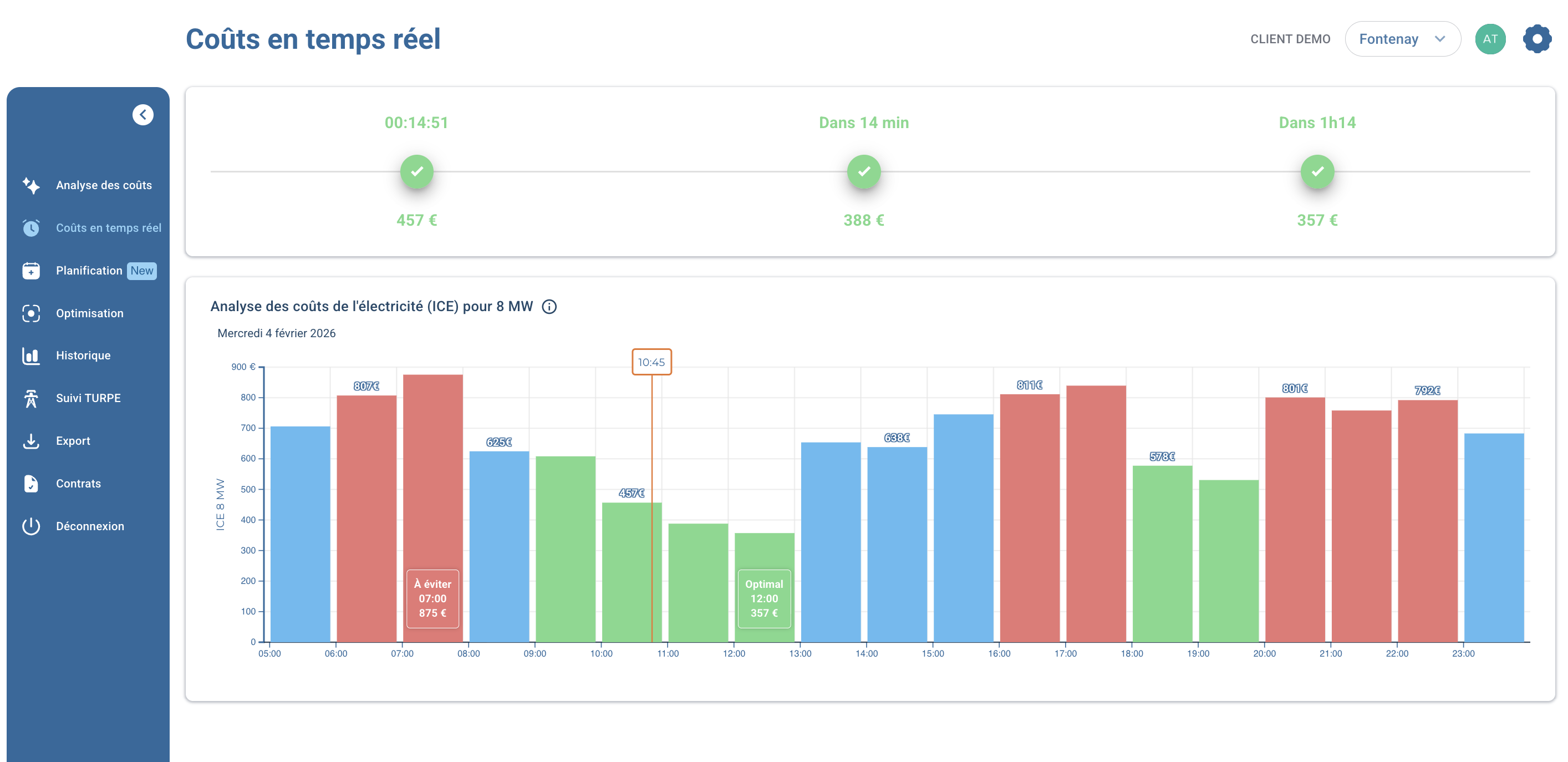
Conclusion: from a “we suffer” mindset to a “we steer” mindset
Energy performance does not depend solely on the negotiated price or on massive investments.
It is based on:
- forecasting
- coordination across functions
- leveraging flexibility
- dynamic management of consumption
Manufacturers who adopt this approach capture significant gains, secure their production and improve their competitiveness.
Looking to optimize your energy strategy?
HIGHCAST can help you shift from a reactive stance to intelligent, data‑driven control.