

Sommaire
1. Visualize energy constraints to better manage production
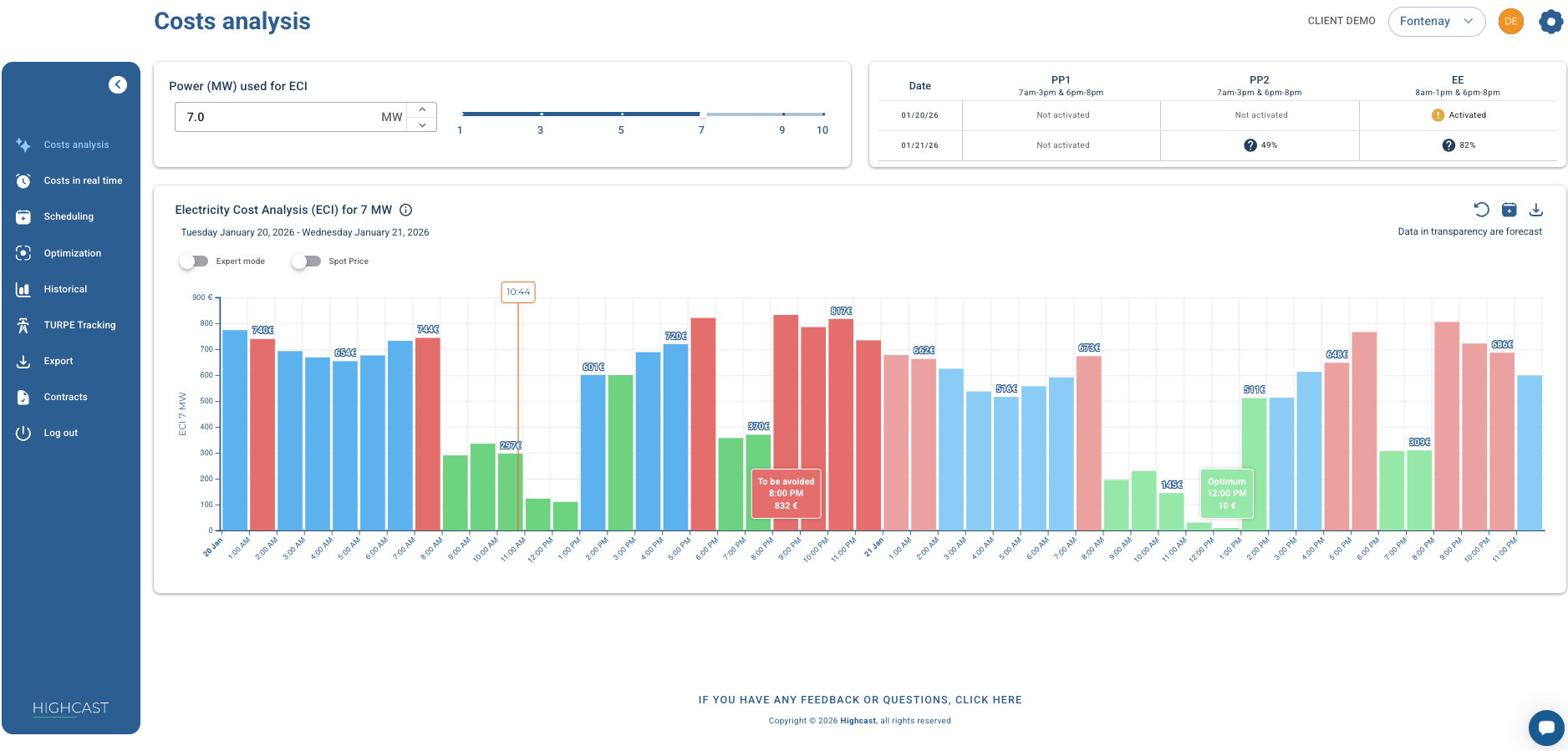
When a production manager logs into HIGHCAST, the objective is immediate: to know when to produce, when to adjust, and when to avoid certain operations, without compromising industrial objectives.
The platform provides a clear overview of:
- favorable electricity price periods,
- intermediate zones,
- periods of high constraint or risk.
This information allows production managers to anticipate sensitive windows, adapt production rates or sequences, and communicate effectively with their teams about upcoming planning.
HIGHCAST translates the energy complexity of electricity markets and contracts into operational signals that can be directly used in production planning.
2. Identify the real margin of maneuver in the process
CContrary to popular belief, flexibility does not mean “stopping production,” but rather organizing production differently, while maintaining the same quality, safety, and volume.
HIGHCAST enables production managers to identify specific opportunities for:
- shifting certain operations,
- modulating production rates,
- adjusting scheduling,
- utilizing intermediate stocks or process inertia,
- reducing or accelerating power consumption at specific times during controlled phases.
These levers are analyzed in the actual context of the site. HIGHCAST integrates existing industrial constraints: operating sequences, minimum and maximum durations, quality thresholds, unavailability, scheduled maintenance, machine limitations, and business rules.
Flexibility thus becomes an industrial management tool, rather than an imposed constraint.
3. Building robust production scenarios
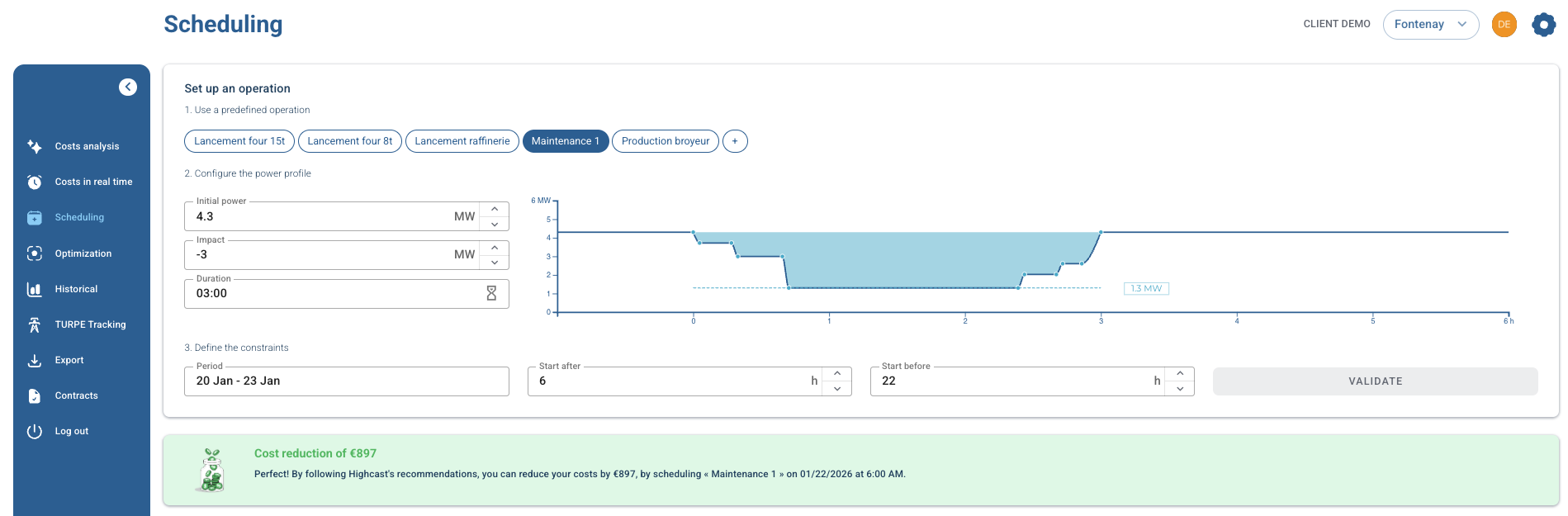
Based on this leeway, HIGHCAST allows production managers to test several operating scenarios before committing.
The planning feature allows you to compare different production organizations by integrating:
- machine targets,
- energy constraints,
- available resources,
- maintenance schedules.
Each scenario is evaluated according to its impact:
- on production continuity,
- on operational robustness,
- on the associated energy cost.
For equivalent production, some organizations are more robust, more resilient, or more economical than others. HIGHCAST allows you to objectively assess these differences before they become constraints in the field.
4. Make decisions with confidence and ensure secure execution
Once the scenarios have been constructed, HIGHCAST activates its optimization engine to propose the most balanced operating modes, compatible with the site's industrial priorities.
The platform identifies:
- the most favorable production windows,
- low-impact speed adjustments,
- points to watch out for.
Each recommendation is accompanied by a clear reading of the financial impacts, allowing the production manager to make quick decisions in conjunction with energy and maintenance.
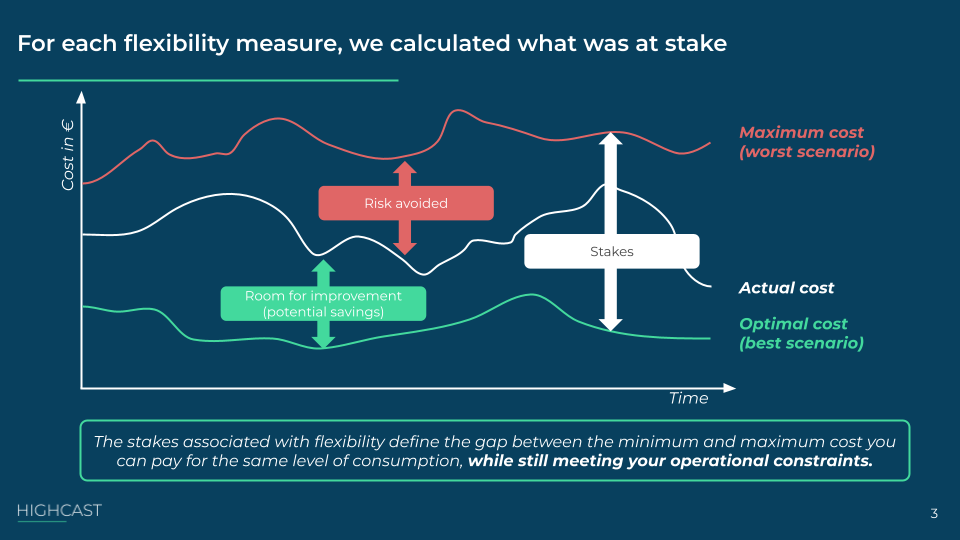
For each period, there is an unfavorable scenario and an optimal scenario. HIGHCAST helps you get closer to the latter, while securing execution and avoiding forced decisions.
Decisions are recorded and shared, ensuring traceability and smooth coordination between teams.
5. Coordinate production, energy and maintenance on a daily basis
HIGHCAST becomes a central coordination tool between business lines. The energy impacts of production decisions are visible, shared, and understood.
Every event—start-up, shutdown, change in pace, maintenance intervention—is tracked and integrated into the analysis. This operational memory makes it possible to:
- capitalize on effective choices,
- anticipate the effects of interventions,
- strengthen collaboration between teams.
Planning becomes a common support, facilitating alignment between industrial performance, energy constraints, and equipment availability.
6. Prepare performance reviews and secure commitments
HIGHCAST facilitates the preparation of weekly or monthly performance reviews. Decisions made, adjustments implemented, and their impacts are documented and exportable.
The production manager has factual information to:
- explain the choices made,
- justify trade-offs,
- identify areas for improvement.
Communication with industrial, energy, and maintenance management becomes clearer and more effective.
Conclusion: HIGHCAST, the production manager's ally
HIGHCAST enables production managers to regain control of electricity costs in an uncertain energy environment. By integrating real-world constraints, the platform transforms electricity into a management lever rather than an imposed constraint.
Beyond optimization, HIGHCAST aligns production, energy, and maintenance around a common vision, secures execution, and enhances industrial performance.
HIGHCAST transforms energy complexity into simple, robust production decisions that can be applied at the right time, in the field.