
Sommaire
Move to operational cost management
HIGHCAST's method relies first and foremost on an evolution of the operational management approach. Rather than seeking to refine only global forecasts, Constellium has opted for a more operational steering approach, focused on the most relevant decision-making level: that of the production and planning teams.
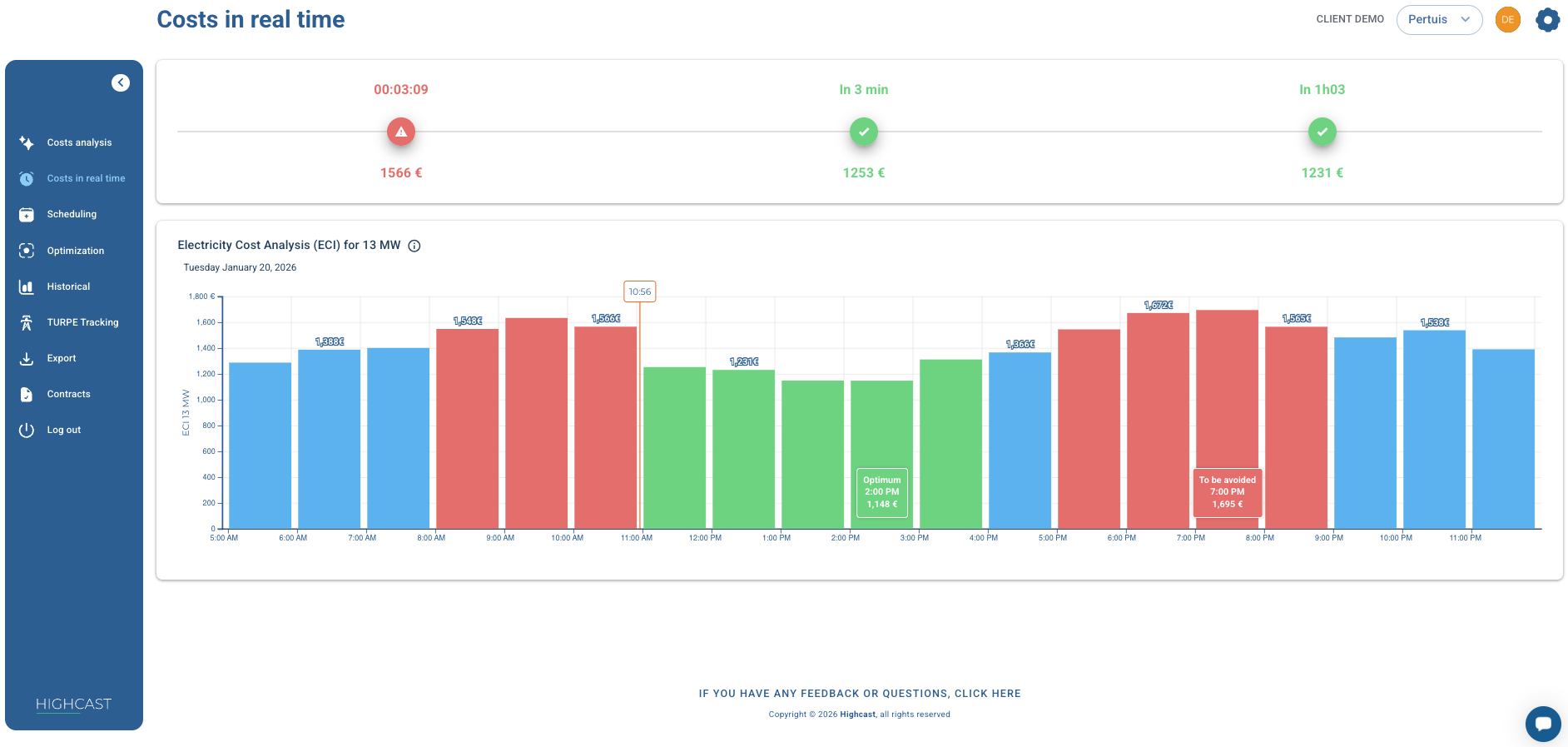
Hourly visibility on electricity prices makes it possible to make informed decisions - whether to start up equipment immediately or delay its launch, maintain or postpone a shutdown - by taking into account their economic impact. Energy thus becomes a clear and quantifiable decision-making parameter, just like the availability of human resources or equipment.
This evolution is accompanied by a change in mindset: economic information is now accessible, usable and shared. Teams have a clear framework for understanding the impact of their choices and making informed decisions, naturally integrating the energy dimension into their daily decisions.
Industrial flexibilities that can be activated immediately
The study conducted with HIGHCAST highlighted several levers of industrial flexibility that could be mobilized without compromising operational performance, with varying levels of effort depending on the case.
The first lever concerns preventive maintenance planning. The decision to schedule equipment downtime within a given week can be made without significant organizational impact, while generating significant cost differences. The data provided by HIGHCAST now makes it possible to inform these decisions, even when external service providers are involved.
A second lever involves optimizing the level of industrial load based on market signals. This approach allows production to be aligned with the most economically favorable periods without impacting operational performance, while improving profitability at a constant load rate.
Finally, on a smaller scale, certain scheduling flexibilities - in the range of one to two hours-can be utilized for start-ups, shutdowns, or scheduling adjustments. These decisions, made directly by field teams, allow companies to take advantage of price variations without affecting industrial performance.
A gradual transformation of operational routines
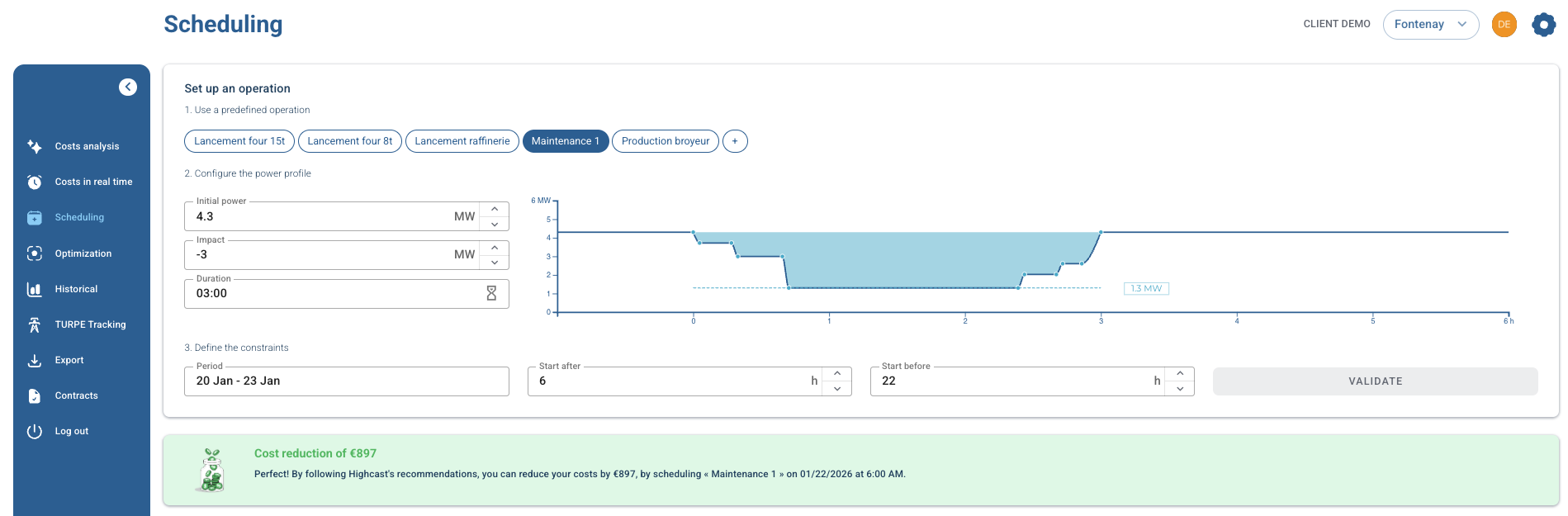
In concrete terms, planning routines have evolved towards a more integrated approach. Planned outages are now decided using a multi-criteria approach, incorporating the cost of electricity in addition to human and technical constraints. When it comes to coordinating several outages over the same period, the focus is on the most relevant combination in terms of price signals.
In the very short term, real-time visibility of hourly costs is a sufficient decision-making tool. Teams rely on a visual reading of price variations to determine simply whether it is appropriate to adjust an operation.
This new management approach increases teams' involvement in the site's economic performance. They no longer simply execute a schedule, but actively participate in trade-offs, with a clear understanding of the link between operational decisions and overall performance.
Benefits beyond the cost of electricity
In hindsight, one of the most significant effects of the initiative has been the spread of a shared culture around energy and economic issues. Technical discussions now more systematically include the issue of electricity costs, which facilitates the prioritization of actions.
The HIGHCAST approach also provides a structured framework for trade-offs: by makingconsumption and associated costs visible, it helps justify the choices made andstrengthen team buy-in.
The next step identified by Constellium is to gradually expand the scope of pilot projects to include less energy-intensive equipment. The challenge will then be to leverage unit optimizations that are modest individually but cumulative over time and significant at the site level. This dynamic relies on regular coordination and reporting to maintain collective commitment.