

Sommaire
1. Understanding and managing costs: the starting point for the energy manager
When an energy manager logs into HIGHCAST, the goal is clear: to immediately understand where costs lie and what messages to convey to the various teams.
The platform is designed as an operational management tool that answers a key question:
How much does my consumption cost today, how much will it cost in the coming days, and where can I take action?
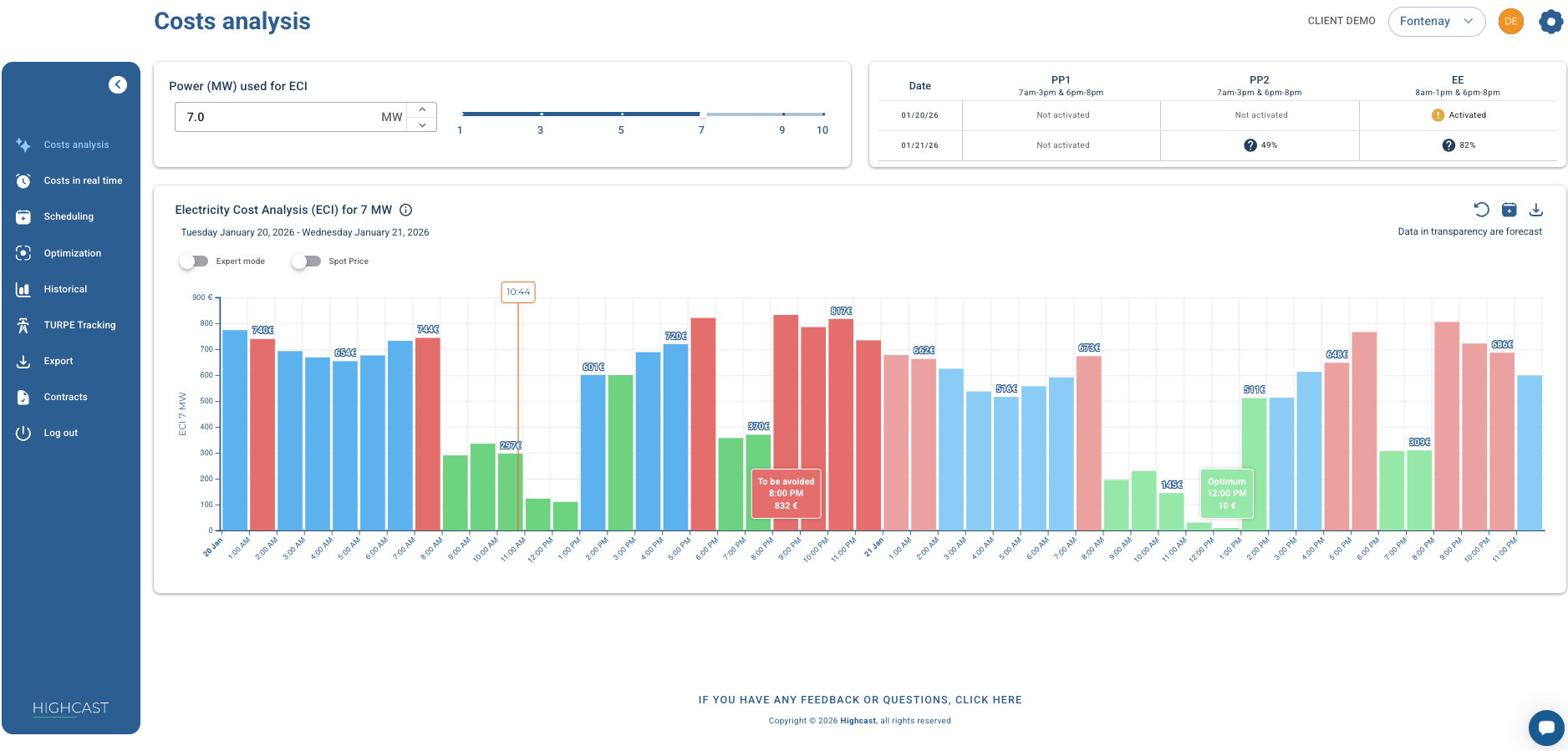
HIGHCAST provides access to a consolidated view of the electricity costs associated with contracts:
- in real time, hour by hour,
- for the current day,
- up to 14 days ahead.
Periods are immediately classified according to their cost level, allowing you to identify at a glance:
- favorable hours,
- intermediate periods,
- and periods to avoid.
This simple reading is essential for sharing information with production.
The Cost Analysis view is the heart of the control system. It transforms data into understandable and actionable arguments.
The energy manager can, in particular:
- adjust the reference power to test several scenarios (acceleration/reduction of production, influence of the spot market on the ICE, influence of subscribed products, transport costs, etc.),
- activate an expert mode to analyze price signals in detail: SPOT is far from being the only parameter affecting ICE variation,
- compare cost forecasts with actual data.
This approach makes it possible to simulate choices, measure their economic impact, and justify operational or contractual decisions to management or production teams.
2. Identify and activate your flexibility: move from reading to action
Once the cost periods have been identified, the challenge for the energy manager is to answer a fundamental question:
where do I really have the capacity to act on my electricity bill without jeopardizing production?
This is where the concept of flexibility comes into its own.
HIGHCAST allows you to identify and activate various flexibility levers, including:
- the timing of certain operations,
- modulating the power of processes or equipment,
- anticipating or postponing energy-intensive phases,
- different scheduling of lines or batches,
- the use of buffer stocks or process inertia,
- the occasional reduction of consumption in targeted areas.
Contrary to popular belief, flexibility does not mean sudden production stoppages, quality degradation, or loss of industrial performance. It consists of exploiting existing margins in the process, which are often known to field teams but rarely formalized or quantified.
To make this flexibility truly actionable, HIGHCAST relies on fully customized planning, tailored to the specificities of each site. The solution integrates real operational constraints in the field:
- production targets,
- operational sequences,
- minimum and maximum phase durations,
- stock levels,
- quality thresholds,
- unavailability,
- scheduled maintenance,
- energy limitations,
- and business rules specific to the process.
Flexibility is thus analyzed in a realistic industrial context, rather than a theoretical one.
In many cases, the difficulty lies not in the lack of flexibility, but in the uncertainty of how to qualify, measure, or prioritize it. If the energy manager is unsure of the levers that can be mobilized at their site, HIGHCAST can also support this process by working with production and maintenance teams to identify, frame, and secure truly exploitable flexibilities.
3. Identify possible scenarios and secure budgets: there is more than one way to produce
Once the levers of flexibility have been identified, the role of the energy manager is to explore the various possible production scenarios and measure their economic impact.
For an equivalent volume of production, there is not just one way to produce, but several possible organizations, with energy costs that can vary significantly.
HIGHCAST's planning functionality allows these scenarios to be constructed, compared, and analyzed before implementation. The energy manager can simulate different production strategies by integrating all industrial constraints: machine targets, operating sequences, phase durations, stocks, unavailability, maintenance, energy limits, and site-specific business rules.
Each scenario is evaluated according to its projected electricity cost, taking into account future price signals, existing contracts, and grid constraints.
Planning thus becomes a tool for budgetary security. It makes it possible to anticipate cost overruns, test assumptions before committing, and provides reliable orders of magnitude for financial management. The energy manager is no longer subject to market conditions: he or she can argue, arbitrate, and align production and budget based on realistic, quantified scenarios.
4. Decide and communicate: transforming optimization into operational decisions
Once the constraints have been defined and the planning scenarios constructed, HIGHCAST activates its optimization engine to identify the most relevant operating modes.
The goal is not to produce a theoretical scenario, but to propose applicable decisions that are compatible with the industrial reality of the site.
Based on price forecasts, operational conditions, equipment status, and available leeway, the solution automatically identifies:
- the most favorable production windows,
- opportunities for modulation or shifting,
- adjustments with low impact on production.
Each recommendation is accompanied by a clear overview of the expected economic gains, potential risks, and operational impacts.
The energy manager and production manager can thus make quick, informed decisions and select the scenario best suited to the priorities of the moment: cost, industrial robustness, security of supply, or production continuity.
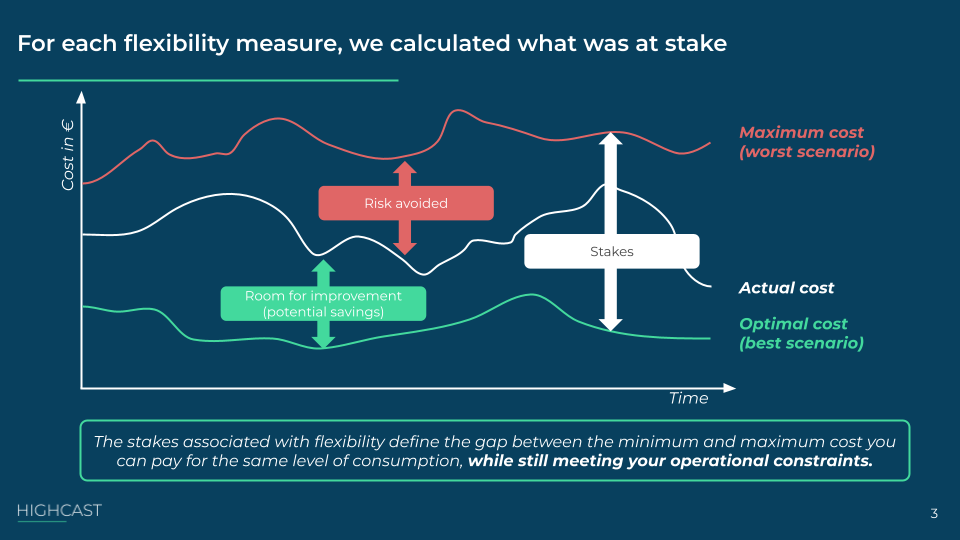
At the start of each new period, there is a worst-case scenario and an optimal scenario for the same production. HIGHCAST provides the keys to managing production on a daily basis in order to systematically move closer to the optimal scenario, avoid market risks, and seize economic opportunities when they arise.
The decisions made are recorded, documented, and shared with the relevant teams. This traceability facilitates coordination between energy, production, and maintenance, and allows companies to capitalize on the choices made.
HIGHCAST thus transforms a complex industrial reality into concrete and actionable recommendations, enabling energy cost control in the long term while ensuring industrial performance on a daily basis.
5. Manage, raise awareness, and secure: make savings sustainable
Thanks to HIGHCAST, the energy manager has access to the actual cost per kWh consumed, shared and understandable to all stakeholders.
This transparency transforms energy management into a collective issue: trade-offs are based on shared data, decisions are objective, and teams align around a clear goal—consume less, at the right time, without jeopardizing production.
Every action carried out on site—starts, stops, speed changes, critical interventions, or one-off adjustments—is tracked and integrated into performance calculations. This operational traceability makes it possible to continuously improve the activation of flexibilities and to make the concrete energy impacts of field decisions visible.
This management approach is also supported by sharing and reporting tools. All HIGHCAST views can be exported (CSV, PDF) to document trade-offs, prepare for energy or management committee meetings, feed internal tools, and ensure continuity of information.
Finally, HIGHCAST helps to secure an often underestimated issue: TURPE. The dedicated monitoring page allows the energy manager to view key indicators, their current levels, their evolution over the year, and their comparison with previous years. This continuous visibility makes it possible to anticipate deviations, adjust usage, and secure reductions at year-end.
6. Effectively prepare the monthly review of electricity costs
HIGHCAST enables energy managers to prepare monthly electricity cost reviews in a structured, factual, and rapid manner.
All the necessary data is already consolidated: actual consumption, associated costs, significant operational events, and arbitration decisions made during the month. The platform facilitates the analysis of budget variances, clearly distinguishing between market conditions, operational choices, and industrial constraints.
Thanks to analytical views and export features, energy managers can produce clear, shareable reports tailored to their interlocutors: production, industrial management, or finance. The savings achieved, risks avoided, and levers not activated are documented, allowing the month’s results to be placed in their operational context.
HIGHCAST is the technical building block that makes it possible to objectively assess performance, capitalize on effective decisions, and identify areas for improvement for the following month, while strengthening collaboration between energy purchasing, production, and maintenance teams.
Conclusion: HIGHCAST, the flexible energy manager's tool
By leveraging a unique Electricity Cost Index (ECI), an energy and industrial digital twin, and optimization AI designed for real-world conditions, HIGHCAST empowers energy managers to regain control of their costs in an increasingly uncertain energy environment.
The platform enables sustainable reductions in electricity bills, secures the site’s energy performance, and activates available flexibilities without disrupting production or maintenance. By integrating operational constraints, downtime, planned maintenance, and equipment status, HIGHCAST aligns energy decisions with industrial imperatives.
Beyond optimization, HIGHCAST becomes a tool for coordination between energy, production, and maintenance. It promotes a common language, a shared vision of costs, and better anticipation of the energy impacts of operational choices.
HIGHCAST transforms energy complexity into simple, relevant, and actionable decisions at the right time and on an ongoing basis.